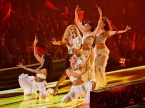
With a global audience and 25 countries taking part, the Grand Final of the world’s largest live music event—organized by EBU member ORF—was held on May 16 at the Wiener Stadthalle in Vienna, Austria, under the theme "United by Music."
Following the performances by the 35 participating countries, the juries announced their votes based on the dress rehearsal held the previous evening. Dara, representing Bulgaria, emerged as the jury favorite. The viewers' votes were then combined with the jury scores, leading to a dramatic conclusion in which Dara was crowned the winner after also securing the public vote. This marks the first time since 2017 that the winning entry has topped both the jury and the public vote.
Second place went to the song "Michelle," performed by Noam Bettan for the Israeli broadcaster KAN.
Third place went to Alexandra Căpitănescu, representing the Romanian broadcaster TVR, with the song "Choke Me." Votes in the final were received from 148 countries—two more than in 2025—including the 35 nations that participated in the 70th contest.
The final result was verified, validated, and confirmed by our voting partner, Once.
The world celebrates music, connection, and inclusivity.
Martin Green CBE, the EBU’s Eurovision Song Contest Director, said:
“Congratulations to the wonderful Dara and BNT; we wish her every success, as the Eurovision Song Contest will serve as a global springboard for her future career. We are extremely grateful to ORF for their outstanding work in organizing this year’s contest, as well as to the city of Vienna and its residents, who opened their hearts and streets to Europe and the world to create an unforgettable celebration of music and unity.”
ORF Director General Ingrid Thurnher added:
“By hosting the 70th Eurovision Song Contest, ORF has delivered a major international event that was followed by millions of people around the globe. The anniversary edition of the world’s largest music show impressively demonstrated what ORF stands for: cultural diversity, openness, and successful cooperation across national borders. Thanks to excellent collaboration with the City of Vienna, the EBU, the delegations, and numerous partners, the contest was delivered at the highest possible level—for which I would like to express my gratitude.
My special thanks also go to the dedicated ORF team, who, over the past few months, prepared and executed the Eurovision Song Contest with great commitment, high motivation, and meticulous attention to detail. The result is an ORF production that once again underscores the importance and success of public service broadcasting on an international stage."
Michael Krön, ORF’s Executive Producer for the Eurovision Song Contest 2026, remarked:
"It has been a great pleasure and an honor to bring such a special and emotional show to life for the 70th anniversary of the Eurovision Song Contest, and to showcase seven decades of its history.
ORF and Austria can look back on a very positive overall outcome for the 2026 Eurovision Song Contest. Given the global reach, the significant promotional impact for Austria, and the high quality of the show, the effort was justified in every respect. Furthermore, ORF was able to break new ground in the area of sustainability; it views the sharing of this experience within the EBU family as part of its long-term responsibility—aiming to make the Eurovision Song Contest even more environmentally friendly and socially responsible in the future. Ultimately, what remains is a wonderful celebration for people brought together by music."
Millions of people around the world watched this year’s contest, which was broadcast live across all participating countries and online. Inside the Wiener Stadthalle, approximately 11,000 people watched the final in person.
Eurovision legends returned to the Eurovision Song Contest stage. This year’s final opened with a performance by last year’s winner, JJ, whose act blended classical influences—inspired by Mozart—with his own unique musical style, while accompanying all 25 finalists on stage.
During the interval, some of the most beloved Eurovision legends returned to the stage to celebrate 70 years of Eurovision hits.
The star-studded lineup included past winners Ruslana (Ukraine, 2004), Alexander Rybak (Norway, 2009), and Lordi (Finland, 2006), as well as Kristian Kostov (Bulgaria, 2017), Max Mutzke (Germany, 2004), and Verka Serduchka (Ukraine, 2007). Also featured were 2025 finalists Miriana Conte (Malta) and Erika Vikman (Finland).
Public service media remains at the forefront of live broadcast technology; the 70th Eurovision Song Contest stands, as ever, as one of the most technically advanced live productions in the world.
Twenty-eight live cameras captured every second as part of a major production upgrade. The entire system was built around cinematic ARRI Alexa 35 cameras, giving the contest a more film-like aesthetic than ever before. A total of 3,107 lighting fixtures, featuring over 28,000 individually controllable LEDs, were used to make every performance unique.
For the first time, the entire lighting setup was fully energy-efficient, relying exclusively on LEDs and lasers.
The stage incorporated nearly 50 million LED video pixels and a custom-built, curved "Infinity Screen" measuring 12m x 8m. With 200 special-effects machines, more than 250 canisters of CO₂, and 45 pyrotechnic firing positions, the production dazzled audiences both at the venue and around the world.
The 70th Eurovision Song Contest was hosted by the Austrian EBU member, ORF, and featured participation from 35 EBU member organizations.
Bulgaria won the Eurovision Song Contest with the catchy track "Bangaranga" by Dara, claiming victory in the 70th edition of the world’s largest live-broadcast music event. The win pushed Israel—whose participation had sparked a major boycott — into second place.
Having sat out the last three editions of this spectacular grand event, Bulgaria secured the crown for the first time in its history in Vienna. The country overtook Israel during the final points-tallying stage, while Romania took third place.
Pop singer Darina Yotova, known as Dara, was not among the favorites heading into Eurovision week; however, the 27-year-old gained momentum following a powerful semi-final performance, which featured elaborately choreographed dance routines.
"Anything is possible—Bulgaria has just won Eurovision!" Dara remarked at a press conference.
"I really like breaking the rules. I’m very good at following my own rules—not someone else’s. We wanted to give the audience something new and fresh—something they wouldn't expect from us."
"A Magnificent Story"
Bulgarian Deputy Prime Minister Atanas Pekanov remarked on Facebook that it was "a magnificent story of immense talent, tireless effort, and belief in success, despite all the criticism."
Around 10,000 glamorous fans packed the Wiener Stadthalle arena in the Austrian capital to watch Saturday’s grand finale of Eurovision—an event where, as always, the dazzling special effects could not entirely mask the geopolitical backdrop.
Spain, the Netherlands, Ireland, Iceland, and Slovenia staged the largest political boycott in Eurovision history over Israel’s participation, citing the war in Gaza.
For a moment, it appeared that Noam Bettan might `win` the contest for Israel with the song "Michelle," following a strong showing in the `public` vote from across Europe.
However, once the points from Bulgaria were revealed, Dara emerged as the winner by a decisive margin.
Bulgaria finished the season with 516 points, ahead of Israel with 343, Romania with 296, Australia with 287, Italy with 281, and Finland with 279.
This marked the second consecutive year that Israel finished in second place.
Johannes Pitsch—known as "JJ," who won Eurovision 2025 for Austria with the song "Wasted Love"—presented the winner’s trophy to Dara.
JJ opened Saturday’s musical spectacle by nodding to Austria’s rich cultural heritage, performing the "Queen of the Night" aria from Wolfgang Amadeus Mozart’s 1791 opera, *The Magic Flute*. "Bangaranga — it’s that feeling that `hits` everyone," Dara `said` earlier on Sunday, as the votes were coming in.
"It’s a moment where you choose to lead through love rather than fear, and that’s a special energy that I know everyone has within them."
Fans streaming out of the arena were reveling in Dara’s triumph.
"At first, I didn’t like the song... but then I saw it—I saw the performance—and I was blown away," `said` Katerina, a Eurovision fan from Greece.
A Finnish Violin and a Romanian Chokehold
The bookmakers’ top favorites heading into the final were the Finnish duo—violinist Linda Lampenius and pop singer Pete Parkkonen—with their song "Liekinheitin," or "Flamethrower."
As the song reached its climax, 56-year-old Lampenius tore through her bow while playing high up on the violin’s fingerboard.
Romanian singer Alexandra Capitanescu shifted the mood with her heavy metal track "Choke Me," which sparked controversy due to the recurring line: "I want you to choke me."
Australian artist Delta Goodrem, who has sold nine million albums, took fourth place, captivating the audience with her song "Eclipse"—a performance filled with powerful moments that culminated in her rising from within a glittering piano.
Serbian metal band Lavina delivered the evening’s deepest, most guttural growls; Czech performer Daniel Žižka navigated a hall of `mirrors`; and Lithuania’s silver-clad Lion Ceccah brought an air of dark, enigmatic mystery.
Protests
Around 166 million viewers watched the contest on television last year, when it was held in Basel.
Earlier on Saturday, hundreds of pro-Palestinian demonstrators marched nearby, chanting "boycott Eurovision" and carrying signs that read "Don't celebrate genocide."
The Spanish public broadcaster RTVE—traditionally one of the main sponsors of Eurovision—not only boycotted the event but also refused to air the show.
At the beginning of the broadcast, it displayed the following message: "The Eurovision Song Contest is a competition, but human rights are not. There is no room for indifference. Peace and justice for Palestine."
On the eve of the final, the Belgian broadcaster VRT stated that it was unlikely to participate in next year’s Eurovision unless the European Broadcasting Union, which organizes the event, holds a direct vote on the issue of Israel’s participation in the contest.
Large crowds of fans boycotted what is usually a joyful and dazzling spectacle; meanwhile, on Saturday, some individuals dressed as clowns outside the arena held a sign reading "United by Genocide"—a play on the contest’s official slogan, "United by Music." Israel denies all allegations that its war in Gaza, launched following the Hamas-led attacks on October 7, constitutes genocide.
Although the booing was not audible on the television broadcast during the performance by Israeli contestant Noam Bettan—much like during Tuesday’s semi-final—loud jeers and boos echoed throughout the arena when he briefly took the lead during the voting phase.
The rest of the contest unfolded as a familiar parade of heavy metal, dance bops, and power ballads. Among them were the Croatian folk-pop entry "Andromeda"—which blends traditional Croatian music with contemporary pop—a French operatic track titled "Regarde!", and Lithuania’s Lev Chekkakh, who appeared covered in silver paint to perform "Sólo Quiero Más," a song about the rise of artificial intelligence. "Humanity, I love you," he remarked afterward.
Finland—the bookmakers' favorite, represented by Pete Parkkonen and Linda Lampenius with a performance featuring pyrotechnics, dark lyrics, and a violin solo—finished in sixth place. Meanwhile, Australian Delta Goodrem—a bona fide pop star in her home country, whose powerful vocals made her another fan favorite—took fourth place. Romania’s Alexandra Căpitănescu came in third.
Bulgarian singer Dara delivered the best staging of the evening with "Bangaranga"—a dizzying whirlwind of tropical pop, named after a term from Jamaican Patois that denotes a "joyful kind of chaos." Her performance felt like a cross between an AA meeting and *The Exorcist*: dancers in plastic chairs jerked and convulsed in time with the song’s constantly shifting tempo.